
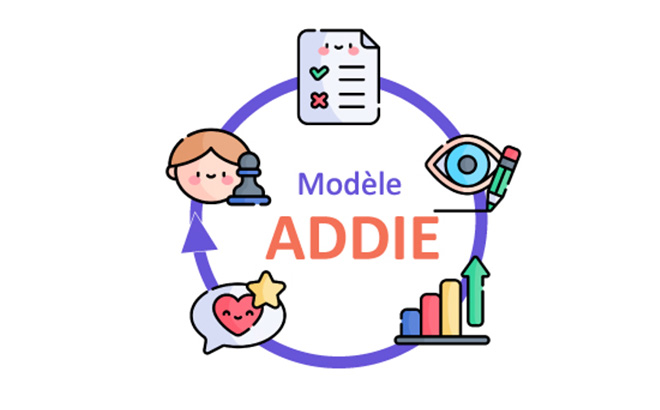
The ADDIE model has been one of the most widely used frameworks in instructional design for over 30 years. It is based on five successive stages: Analysis, Design, Development, Implementation, and Evaluation. Each of these phases directly contributes to the success of a training project.
What Does ADDIE Mean?
Each letter of the acronym represents a stage in the process. The model is considered sequential (or “waterfall”) because each phase logically follows from the previous one.
A – Analysis
This is the starting point of the model. The analysis phase involves identifying training needs, objectives, learner profiles, as well as time, budget, and contextual constraints. Analysis provides the foundation on which the entire instructional design is built.
D – Design
The second phase corresponds to instructional design. At this stage, designers define learning objectives (distinct from overall training goals), structure the content, and choose the appropriate tools. This phase often produces two deliverables:
-
Storyboard: a document detailing text, images, interactions, voiceovers, etc.
-
Prototype: a preliminary version of the module that allows testing usability, anticipating technical issues, and visualizing the project.
D – Development
This phase implements the structure defined in the previous step. It involves producing learning resources: materials, media, interactive content, and learning activities.
I – Implementation
This is the rollout phase. The training is launched and made accessible to learners. Depending on the format, actions differ:
-
In-person: printing documents, preparing logistics, booking rooms.
-
Online: deployment on a LMS or other online platform.
E – Evaluation
The final stage of the cycle, evaluation measures the relevance and effectiveness of the training. It can occur at several levels:
-
Learners’ achievements (what did they retain?)
-
Their satisfaction and perception of the program
-
Return on investment for the organization
Evaluation is not only performed at the end; it can take place throughout the process to adjust and improve each stage.
Variations of the ADDIE Model
Over time, enhanced versions of the model have emerged:
-
ADDIEM: adds a Maintenance phase to improve and update content and tools.
-
PADDIE+M: adds two phases:
-
P (Planning) at the start to set the project schedule and milestones
-
M (Maintenance) at the end to ensure the sustainability of the program
-
Advantages of the ADDIE Model
-
Flexibility: it can be applied to individual or group training, in-person or online.
-
Clear structure: the five stages provide a solid methodological framework for designing effective learning programs.
-
Integrated approach: it links training needs to expected behaviors, making it easier to evaluate results.
Limitations
ADDIE is still an older model. Used too linearly, it may lack flexibility compared to newer, iterative methods, which can sometimes perform better in dynamic environments.
Key Takeaways
- The ADDIE model is based on five main stages: Analysis, Design, Development, Implementation, and Evaluation.
-
Enhanced versions exist: ADDIEM and PADDIE+M.
-
It is adaptable to various training contexts.
-
While still widely used, it is increasingly complemented by more modern and agile approaches.